Read the Plate, Read the Decade: What a Saturday Fry-Up Reveals About Your Vascular Future
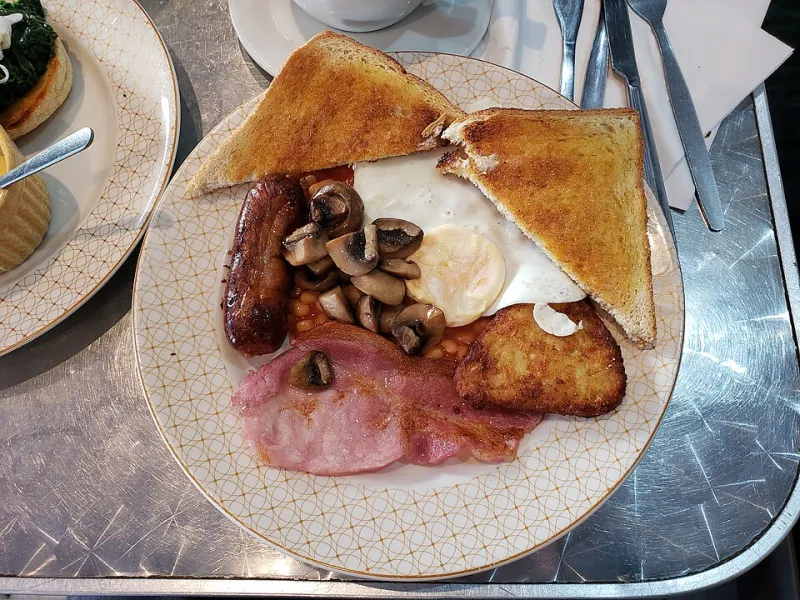
Photo: Andy Li, CC0, via Wikimedia Commons
There is a ritual to the British Saturday morning. For some men it is the full English at the greasy spoon after the park run they didn't do. For others it is a bacon roll from the van at the car boot sale, or a can of energy drink cracked open somewhere between the school run and the hardware shop. As a GP, I have learned that what a man eats between 8am and 11am on a Saturday tells me a remarkable amount about the following ten years of his life.
This is not about guilt. It is about what clinicians call a dietary snapshot — a single meal that functions a little like a blood film under the microscope. The plate reveals habits, the habits reveal risk, and the risk, if left unexamined, quietly writes the next decade.
The Full English: A Cardiovascular Ledger
Start with the classic. Two sausages, three rashers, fried bread, beans, a fried egg and a mug of tea. On its own, once a month, this meal is a pleasure and largely harmless. The clinical concern is frequency and context.
Processed meats — bacon, sausages — are associated in large cohort studies with increased cardiovascular events, largely through their sodium content, saturated fat and nitrite preservatives. For a man over 40 whose blood pressure is already drifting upward and whose LDL cholesterol is no longer the effortless number it was at 30, a twice-weekly fry-up is not a neutral act. It is a slow deposit into a ledger you would rather not overdraw.
The frying method matters too. Reusing oil, frying at high heat and adding fried bread all compound the oxidised lipid load. Swap the fry for the grill, the bacon for kippers or smoked salmon once in a while, and the beans — genuinely one of the better items on the plate — stay.
The Bacon Roll: The Metabolic Warning in a Handheld Format
The bacon roll deserves its own paragraph because it hides in plain sight. It does not look like a meal, so men do not count it as one. Yet a white bap with three rashers and brown sauce delivers refined carbohydrate, a sodium spike and processed meat in a single, convenient package — often eaten standing up, often followed by nothing green for another six hours.
The white bread matters more than most men realise. Repeated refined carbohydrate loads drive post-prandial glucose spikes, and over years those spikes are a major driver of insulin resistance — the pathway that eventually shows up on a blood test as a raised HbA1c, a creeping waist circumference and, less obviously, a decline in free testosterone. Visceral fat is not just a cosmetic issue; it is hormonally active tissue that converts testosterone to oestrogen and drives inflammation.
The simple fix is not abstinence. It is a wholegrain roll, two rashers instead of three, and an egg added for protein that blunts the glucose curve. Small arithmetic, applied weekly, changes the trajectory.
The Energy Drink on the School Run
Few items on the modern British morning landscape concern me more than the habitual energy drink. A single 500ml can delivers roughly 160mg of caffeine — the equivalent of four espresso shots — alongside a sugar load approaching or exceeding a man's entire recommended daily allowance.
The acute effects are well documented: a rise in blood pressure, a modest but real increase in heart rate, and a cortisol surge layered on top of whatever stress the week has already banked. For men in their forties, whose sleep architecture is already fragile and whose blood pressure is often already treated or treatable, this is a poor trade. The afternoon crash that follows also drives the very snacking that undermines metabolic health.
Coffee, unsweetened, is a defensible alternative with a genuinely favourable evidence base. The swap is unglamorous and it works.
What the Plate Predicts
When I look at a Saturday breakfast, I am mentally running three predictions. First, cardiovascular: sodium, saturated fat and processed meat point towards the blood pressure and cholesterol readings I will see at the next review. Second, metabolic: refined carbohydrate and portion patterns point towards HbA1c and waist measurement. Third, hormonal: visceral fat and poor glycaemic control are among the most common reversible contributors to low testosterone in men over 40.
None of this requires a fry-up ban. It requires honesty about frequency, and an understanding that midlife physiology punishes the same dietary inputs that the 25-year-old body shrugged off.
The Ten-Year Swap List
Three changes carry disproportionate value. Replace the fried breakfast's cooking method rather than the meal itself — grill, poach, add tomatoes and mushrooms. Upgrade the white bap to wholegrain and add protein to blunt the glucose spike. Retire the daily energy drink in favour of coffee or water, and let your sleep and blood pressure do the thanking.
A decade is roughly five hundred Saturday breakfasts. No single one decides anything. The pattern decides everything — and the pattern, unlike your genes, is entirely yours to edit.